
Case Study - The Future of Generative Commerce
Renda AI revolutionizes interior design by generating realistic room renderings with shoppable products — bridging the gap between inspiration and implementation in seconds rather than weeks.
- Client
- Renda
- Year
- Service
- AI Integration, Web Development
Overview
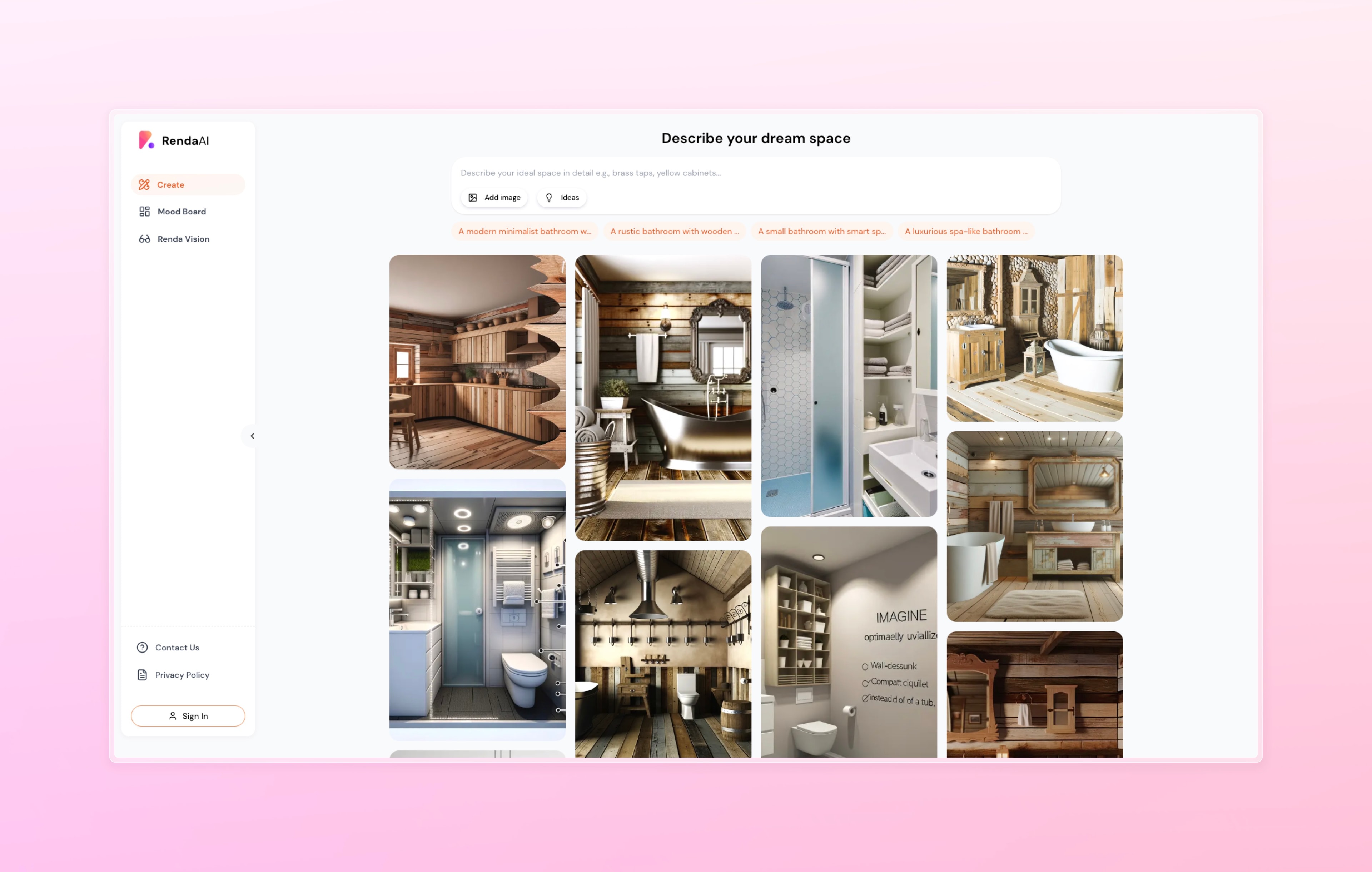
Envisioning your dream bathroom, you scroll through Pinterest, TikTok, and Google to find inspiration. After sifting through hundreds of images that don't quite match your vision, you finally discover the perfect bathroom design. Only problem — where do you even start looking for the products that bring it to life? With countless brands, styles, and price points, the search can quickly become overwhelming. The journey from inspiration to purchase is broken. Inspiration content lives on platforms designed for engagement, not commerce. Commerce platforms are organised around products, not rooms. The user has to mentally bridge the two, and most don't — they scroll, save, and never buy. Renda AI partnered with us to collapse that gap entirely: start from a prompt, end with a room and a basket.
We developed the Renda AI platform — a generative image pipeline that transforms a prompt into stunning, realistic interior visualisations complete with ready-to-shop product baskets. In just seconds, users watch one simple prompt transform into a collection of curated interiors that look photographed rather than rendered. The generation pipeline is intentionally model-agnostic: the initial MVP shipped on one image-generation backbone; later sprints swapped it for a more advanced model with the rest of the application — auth, mood-board logic, product matching — untouched. That decoupling matters: image-generation quality has reset roughly every six months, and the platform shouldn't have to be rewritten every time a better model lands.
The AI integration sits behind well-defined API endpoints, so new models plug in without touching the UI contract or the surrounding application. Each generation pass returns both the rendered image and the structured product metadata that powers the shoppable basket, so the interior and its commerce layer are produced in the same step rather than reconciled afterwards. The platform reframes interior shopping around the room rather than the product. Try it yourself at renda.app.
What we did
- Next.js Frontend
- Django Backend
- Model-agnostic AI pipeline
- Shoppable product matching
- Average rendering time
- 8s
- Product match accuracy
- 92%
- Conversion rate increase
- 45%
- Daily renders
- 10K+